The Vitruvian Man: A Naked Man, Two Shapes, and Our Old Hunger for Order
Vitruvius: Marcus Vitruvius Pollio, a Roman architect and engineer whose ideas about proportion influenced Leonardo’s drawing.
De Architectura: Vitruvius’s old Roman treatise on architecture, engineering, temples, machines, proportions, and the belief that good design should follow order.
Renaissance: The European cultural period, roughly from the fourteenth to seventeenth centuries, when old Greek and Roman learning returned to fashion and people began poking nature, art, anatomy, machines, and mathematics with dangerous curiosity.
Polymath: A person who works seriously across many fields. Leonardo was one of the terrifyingly gifted specimens.
Euclidean geometry: The geometry of lines, circles, squares, angles, and shapes, named after Euclid, the ancient Greek mathematician whose work became the schoolmaster of Western geometry.
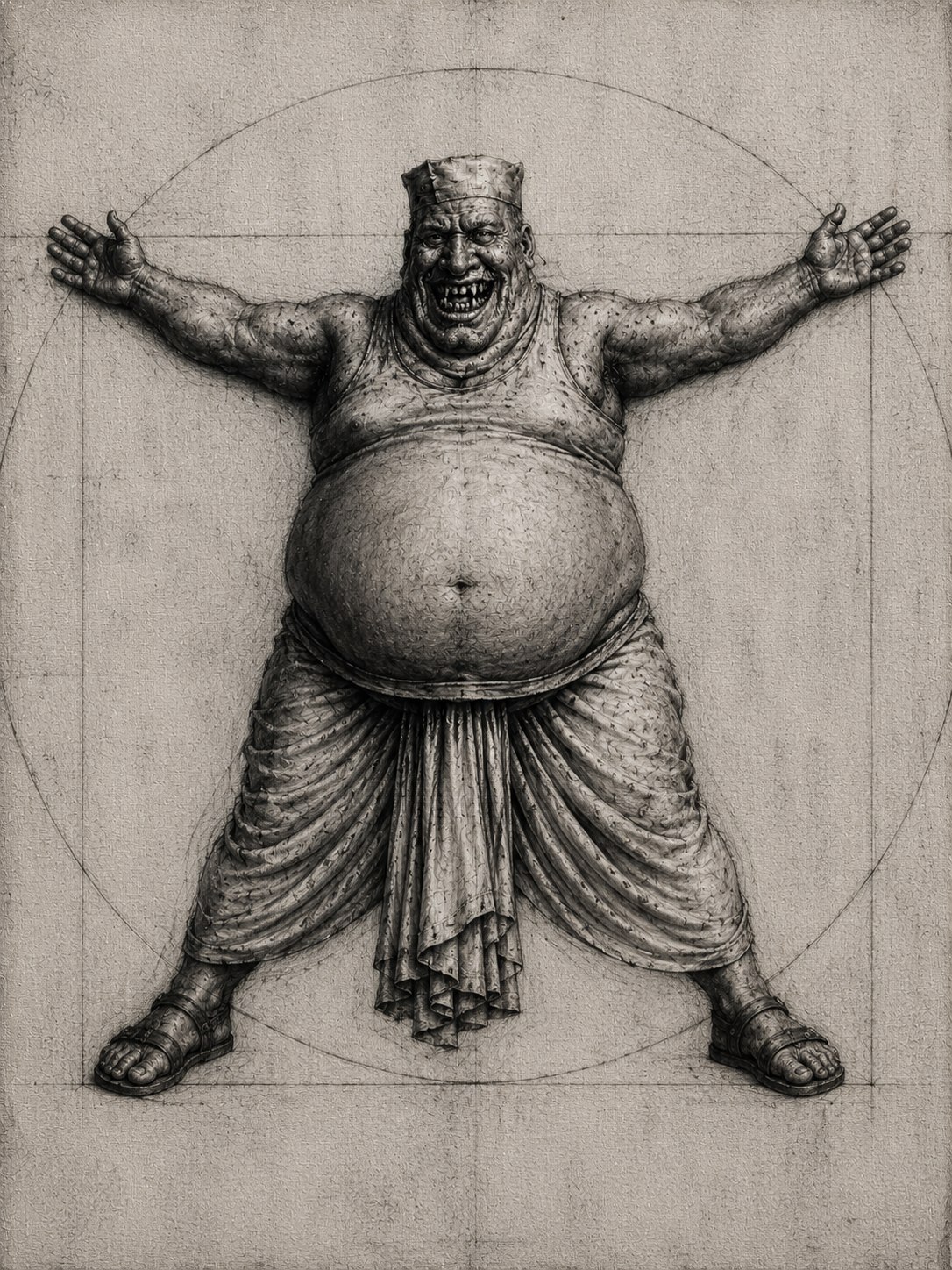
The Vitruvian Man is what happens when a genius looks at the human body and says, “Fine, you have knees, ribs, hair, hunger, pride, back pain, and terrible judgment. But can you fit inside a circle and a square?”
That is the whole mischief.
At first glance, it is just a naked man doing what looks like a disciplined star-jump inside two polite geometric shapes. One circle. One square. Arms and legs spread. Face calm. No electricity bill. No landlord. No cholesterol report. No morning in Calcutta where the fan is spinning like a tired government clerk and still the room feels like someone has wrapped the city in a wet towel.
And yet this little drawing has become one of the most famous images in human history.
It appears on mugs, posters, medical conference banners, school notebooks, office walls, wellness pamphlets, startup logos, and tattoos acquired by young men in emotional weather. It has been dragged through civilization like a brass band at a wedding procession: noisy, overused, slightly ridiculous, but still impossible to ignore.
The joke is that the original drawing is not ridiculous at all.
Leonardo made it around 1490, probably in Milan, while thinking through an old Roman idea from Vitruvius. Vitruvius had claimed that good buildings should have proper proportions, and that the human body itself gave architects a model of harmony. The body was not merely a walking arrangement of bones and complaints. It was a measuring device. A small map of order.
Now give that idea to Leonardo and see what happens.
An ordinary person might have nodded, eaten something, and gone home. Leonardo, unfortunately for the peace of mankind, was not ordinary. He had the kind of mind that could not see a hand without wondering about tendons, leverage, proportion, motion, beauty, and whether the universe was secretly hiding a ruler behind its back.
So he drew the body as geometry.
The man’s outstretched arms roughly match his height. The navel becomes the center of the circle. The square anchors the body differently. The legs shift. The arms shift. The figure seems to be standing in two arrangements at once, like a patient in a tailor’s shop who has been told to hold still while the tailor, drunk on mathematics, measures him for eternity.
This is not a pin-up. It is not fitness inspiration. It is not proof that men should go around looking like well-fed marble statues.
It is a question in ink.
Can the human body express order?
That is the little bomb hidden inside the drawing. You think you are looking at a famous naked fellow from an art-history textbook. Actually, you are looking at an argument about whether the human being belongs to the same world as temples, circles, squares, columns, stars, measurements, and ideals.
This is why the circle and square matter.
The square feels earthly. Practical. Boxy. Four-sided. Like a room, a courtyard, a table, a ration-card office, a school exercise book, a bed pushed against the wall in a small flat where everything must fit because life has not been generous with square footage.
The circle is different. The circle is smooth. It has no corners. It suggests completeness, perfection, planets, halos, wheels, bangles, coins, the lid of a steel tiffin box, the moon over a smoky railway platform. It feels like something the mind wants even when the body is tired.
Leonardo places man inside both.
That is the magic.
And also the comedy.
Because actual human beings are not like this. We are not clean diagrams. We are uneven, dented, improvised creatures. One shoulder aches. One knee clicks. One eyebrow behaves better than the other. We gain weight around the middle and lose hair where it would have been useful. We sit too long, sleep badly, eat too quickly, worry about money, and then look at a Renaissance drawing and think, “Yes, yes, human perfection. Very good.”
In the southern fringe of Calcutta, where I live an ordinary middle-aged life among broken roads, damp walls, tea stalls, passing scooters, and the daily opera of survival, the Vitruvian ideal can seem like a joke told by someone who never stood in a ration queue or waited for an online payment to fail twice. Universal harmony is lovely. But the plumber is late. The medicine strip is almost finished. The laptop fan is making a noise like a philosophical mosquito.
Still, the drawing gets under the skin.
Why?
Because it does not show us as we are. It shows us as we suspect we might have been meant to be, before life started editing the manuscript with a blunt knife.
Leonardo’s notes around the drawing are full of measurements. Hand to height. Foot to body. Chin to hairline. Elbow to fingertip. He was not merely admiring the body. He was studying it like a locksmith studies a complicated lock. If the proportions could be understood, perhaps the body had a grammar. Perhaps beauty was not just personal taste. Perhaps nature had rules.
That “perhaps” is the hook.
The whole drawing lives inside that “perhaps.”
Perhaps man is a measure of the world. Perhaps the body is architecture with a pulse. Perhaps geometry is not cold abstraction but a quiet music hiding inside flesh. Perhaps the universe, which otherwise behaves like a distracted cook, occasionally arranges things with elegance.
But here is the catch.
Ideals are useful until they start scolding reality.
No real body is the Vitruvian body. Bodies carry history. Childhood nutrition. Work. Illness. Age. Injury. Stress. Pregnancy. Disability. Class. Food. Sleep. Anxiety. Luck. Bad luck. Terrible chairs. Worse shoes. Years of standing, sitting, lifting, bending, typing, waiting, enduring.
A body is not only measurement. It is biography.
That is why the drawing is beautiful and dangerous in the same breath. It gives us a clean body without the weather of living. No fever. No debt. No loneliness. No depression sneaking in at four in the afternoon when the room is too quiet and the day has gone strangely shapeless. No aging man looking in the mirror and thinking, with comic unfairness, that Leonardo has done the rest of us a grave public-relations injury.
And yet we return to it.
Not because we believe it literally. Not because we expect to become that fellow in the square. Most of us would pull a muscle attempting the pose. Some of us would require medical attention, a hot compress, and strong tea.
We return because the drawing says something tender beneath all the geometry.
It says disorder may still contain pattern.
That is a powerful thought. Especially now, when the world itself often feels badly proportioned. News arrives every morning like a badly packed suitcase: war here, election drama there, climate anxiety, artificial intelligence eating jobs, markets wobbling, politicians talking as if language were a leaking tap, and ordinary people everywhere trying to keep the monthly accounts from staging a rebellion.
In such a world, a small drawing of a human figure calmly fitted into order has strange emotional force.
It is not proof.
It is comfort with a compass.
Leonardo did not simply worship perfection. That would have made him dull. He studied the machinery of the imperfect. Muscles. Bones. Tendons. Movement. Anatomy. He wanted to know how things worked. His beauty was never just decorative; it had screws, pulleys, shadows, joints, errors, corrections. He was not selling motivational posters. He was opening the body like a mystery box.
That is why the Vitruvian Man still survives beneath the merchandise.
Strip away the mugs, the logos, the lazy tattoos, the wellness brochures, the corporate nonsense about balance, and the original image still stands there, calm and insolent. A man. A circle. A square. A mind trying to prove that flesh and mathematics are not enemies.
It is a noble idea.
It is also slightly absurd.
Which is often where the best human ideas live.
We are animals who make diagrams of ourselves. We are meat that dreams of symmetry. We are crooked creatures drawing straight lines and hoping the lines will forgive us.
That, to me, is the charm of the Vitruvian Man. He is not real. He never was. Nobody lives inside a perfect circle. Nobody pays rent inside universal harmony. Nobody wakes up with a stiff neck and says, “Today I shall embody classical proportion.”
But the unreality is the point.
Leonardo gives us not the human body as fact, but the human body as aspiration. Not perfection, exactly. That would be unbearable. More like a rumor of order. A whisper that beneath the swelling, sweating, limping, laughing, aging confusion of us, there may still be some hidden geometry worth looking for.
And if not?
Well, there is always tea.